
Knowing When to Step Back: Why Parents Should Be Cheerleaders, Not Coaches
Positive Word Association in Coaching
Youth sports require a tremendous amount of commitment from parents. We drive to practices, spend weekends at tournaments, pay for equipment, rearrange schedules, and sit through games in the heat, cold, and everything in between. Naturally, we want our kids to succeed. When we see something they could have done differently, the instinct to help is almost automatic.
Sometimes, though, the best thing a parent can do for an athlete is step back.
There is an important difference between supporting your child and coaching your child. When a player is receiving instruction from a coach, then hearing a different set of instructions from a parent during the game, after the game, or on the drive home, it can become difficult for the player to know who to listen to. Even when both people mean well, conflicting information can create hesitation, frustration, and unnecessary pressure.
In baseball, that can happen very quickly. A coach may be working with a hitter on staying balanced and recognizing the ball longer. A parent watching from behind the fence may see a called third strike and immediately tell the player to be more aggressive. Neither instruction is necessarily wrong in isolation, but now the player has two different problems to solve at the plate.
Instead of reacting naturally to the pitch, the athlete starts thinking.
And when a hitter starts thinking about five different mechanical cues in the middle of an at bat, we have usually made the job harder, not easier.
Players Need One Coaching Voice
One of the most important parts of player development is consistency. Coaches need the opportunity to identify problems, work through them, and give athletes time to make adjustments.
At Vicarious Athletics, I spend a lot of time looking beyond the immediate result. A strikeout does not necessarily mean there is something wrong with a swing. A weak ground ball does not automatically require a mechanical change. Sometimes the issue is timing. Sometimes it is pitch recognition. Sometimes it is approach. Sometimes the player did everything correctly and simply got beat by a good pitch.
Good coaching is about identifying the root cause before trying to fix the symptom.
That matters because players, especially younger ones, can only process so much information at once. If a coach is working on one specific adjustment and a parent adds two or three more from behind the fence, the player can suddenly find themselves trying to correct everything at the same time.
That is when mechanics can become rigid, confidence can drop, and a natural athletic movement starts becoming something the player is consciously trying to assemble piece by piece.
The goal is not to fill an athlete's head with instructions. The goal is to teach them well enough that eventually they do not need to think about the instructions at all.
Why I Use Favorite Foods as Coaching Cues
One technique I use with my students is positive word association.
I ask each player to tell me one of their favorite foods. It might be pizza, tacos, sushi, pancakes, or whatever immediately makes sense to that particular kid.
Then I attach that word to the things we have been working on.
I will tell them, "When you hear your word, I want you to remember your stance in the box, relax your shoulders, and swing with your belly button."
"Swing with your belly button" is my way of teaching a young hitter that the hips initiate the swing. I could tell a child to engage their lower half, sequence the pelvis before the torso, maintain separation, and allow the hands to follow the rotation.
Or I can tell them to swing with their belly button.
One of those is much easier to remember when a pitcher is throwing a baseball at you.
The same idea applies to the favorite food. The food itself has nothing to do with hitting. It is simply a positive, memorable trigger that gives the player access to a group of things we have already practiced.
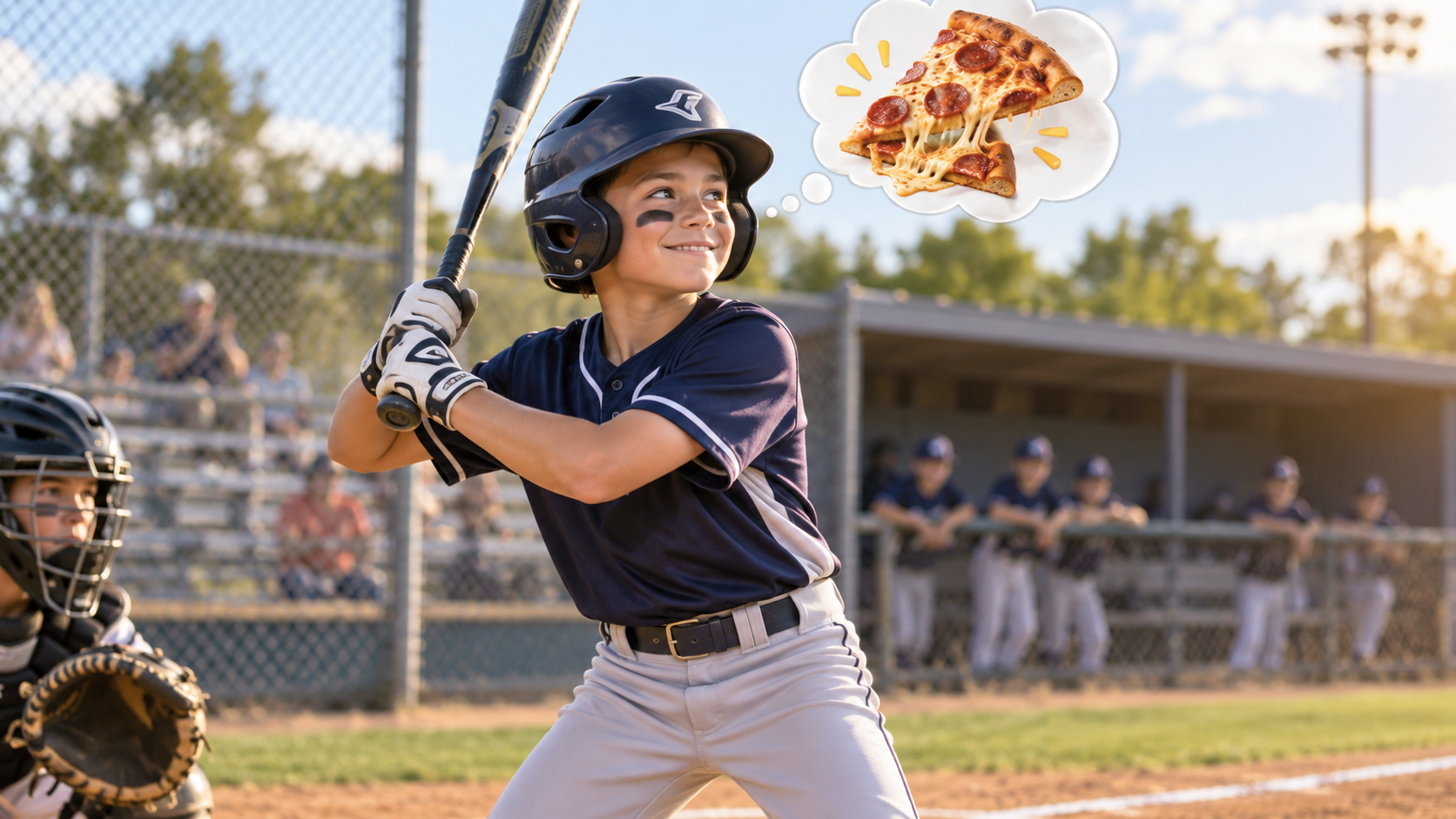
If a player's word is "pizza," I do not need to stand outside the cage saying, "Fix your feet. Relax your shoulders. Use your hips. Don't lead with your hands. Stay balanced."
I can say, "Pizza."
The player knows what that means.
That is the important distinction. The cue does not replace coaching. It represents the coaching that has already taken place.
Over time, that one word becomes associated with a familiar stance, a relaxed body, and the movement pattern we have practiced repeatedly. It allows the player to simplify everything we have worked on into something they can recall almost instantly.
That is exactly why additional instructions from the stands can be so disruptive.
If I have spent weeks building an association where "pizza" means, "Get comfortable, relax your shoulders, use your hips, and trust your swing," and a parent suddenly yells, "Keep your elbow up!" or "Don't drop your hands!" we have just added another thought into a process we deliberately worked to simplify.
The parent may even be technically correct.
That does not mean the instruction is helpful in that moment.
Good coaching does not always mean giving an athlete more information. Sometimes it means figuring out how to say less.
The Fence Is Not a Coaching Box
Parents absolutely have a role during games, and it is an important one.
Cheer.
Celebrate effort. Celebrate teammates. Encourage your child after a mistake. Applaud a hard hit even if somebody catches it. Recognize a good defensive play. Help create an environment where kids enjoy competing.
What players generally do not need is pitch by pitch mechanical instruction coming from the stands.
"Move up in the box."
"Keep your elbow up."
"Don't drop your hands."
"Swing harder."
"Watch the outside pitch."
Even technically correct advice can become counterproductive when it arrives while a player is trying to compete. Baseball already requires an enormous amount of processing in a very short period of time. A hitter is watching the pitcher, identifying the pitch, determining whether it is a strike, deciding whether to swing, and coordinating a complex movement pattern in a fraction of a second.
The goal of practice is to make as much of that as automatic as possible.
When a player walks into the batter's box, I do not want them consciously thinking about every joint in their body. I want them to trust the movement we have trained.
Sometimes that means the only thing they need to hear from me is the name of their favorite food.
Adding another voice from behind the fence usually does not make that process easier.
It is also important to understand that the coaching process may not always be obvious from the stands. A parent may see a player's hands in a certain position and assume the coach has not noticed. The coach may be intentionally leaving that alone because they are working on something more fundamental first. A parent may think a hitter needs to be more aggressive, while the coach may deliberately be teaching that player to improve pitch selection.
Player development is rarely about fixing everything at once. Sometimes the most important coaching decision is deciding what not to correct yet.
Be Careful With the Car Ride Home
The car ride after a game can be just as important as the game itself.
For adults, it can feel like the perfect opportunity to review what happened. We remember the strikeout, the missed ground ball, or the base running mistake and want to talk through it while everything is still fresh.
For the player, however, the game may already be over.
Sometimes the best thing you can say after a game is simply, "I loved watching you play."
If your child wants to talk about the game, listen. If they ask what you thought, have the conversation. But not every game needs an immediate performance review.
This is particularly important if the player is already working with a coach. When a child receives one set of instruction during practice, another from the dugout, another from the stands, and then a fourth version during the ride home, it becomes increasingly difficult for them to know what they are actually supposed to work on.
Athletes also need opportunities to process their own successes and failures. Learning to recognize what went well, what went poorly, and what they might do differently next time is part of becoming an independent player.
If adults immediately provide every answer, we can unintentionally take away some of that learning process.
The ride home should not feel like another coaching session.
Let Players Struggle
This may be the hardest part for parents.
Watching your child struggle is uncomfortable. When we know something that might help, doing nothing can feel irresponsible.
But struggle is part of development.
A player who strikes out three times has an opportunity to learn how to respond to failure. A pitcher who cannot find the strike zone has an opportunity to learn how to reset. A fielder who makes an error has an opportunity to discover whether they can mentally recover before the next pitch.
Those experiences are valuable precisely because a parent cannot solve them from the stands.
Part of what I am trying to build with simple cues like positive word association is independence. Eventually, I want that hitter to step into the box, remember their word, relax, and make their own adjustment.
I do not want them looking toward the dugout after every pitch waiting for me to tell them what to do.
And I certainly do not want them looking toward five different adults for five different answers.
The goal of youth sports should not be to eliminate every difficult moment. It should be to give young athletes the tools and confidence to work through those moments themselves.
Parents and Coaches Should Be on the Same Team
None of this means parents should never ask questions or discuss their child's development with a coach. In fact, communication between parents and coaches can be extremely valuable.
The difference is where and when those conversations happen.
If you see something you are concerned about, talk to the coach away from the game. Ask what they are working on with your child. Ask whether there is something you can reinforce at home.
You may discover that the coach already sees exactly what you see, but is intentionally working through the problem in a particular sequence.
You may also discover that a strange little word your child keeps hearing during practice actually has a purpose.
If one of my players tells you that I keep yelling "tacos" at them from the other side of the cage, there is probably a little more going on than lunch.
That word may represent weeks of work on their stance, relaxation, hip rotation, and confidence in the box.
That is why communication matters.
A good coach should be able to explain not only what they are working on, but why. And a parent who understands that process can become an enormous ally in the athlete's development.
The goal is not to remove parents from the development process. It is to give everyone the right role within it.
Give Them Something Bigger Than Instruction
Most youth athletes will eventually forget the score of a particular game. They will forget how many hits they had in a tournament and probably forget most of the mechanical adjustments they worked on during a season.
They are much more likely to remember how playing made them feel.
They will remember whether they looked toward the stands after striking out and saw frustration or encouragement. They will remember whether the ride home felt like a second coaching session or a chance to relax with their parent. They will remember whether success felt like something they wanted for themselves or something they needed to achieve for someone else.
Parents have enormous influence over a young athlete's relationship with sports. Coaches can teach mechanics, biomechanics, approach, strategy, and fundamentals, but parents often shape the emotional environment surrounding the game.
Sometimes the best way to help your child improve is not by adding another instruction.
Cheer for them. Support them. Let them struggle. Trust the development process.
And if their coach yells "pizza" from across the field, there is probably a reason.

When does Travel Ball make sense?
Kids joining a baseball team
Spend enough time around youth baseball and eventually someone will ask the question: When should my kid start playing travel ball? For some families, that question comes surprisingly early. Eight year olds are playing tournaments, nine year olds are being invited to tryouts, and parents start hearing about rankings, select teams, tournament rings, and weekend baseball several cities away. It can create the feeling that if your player is not already playing travel ball, they are falling behind. In most cases, they probably are not.
Travel ball can be a great experience. It can give players more repetitions, expose them to stronger competition, and put them in an environment where coaches can spend more time developing specific skills. But travel ball only makes sense when the player is ready for it, and when the program they join is actually helping them become a better baseball player.
So, What Age Should a Player Consider Travel Ball?
At Vicarious Athletics, we think around 10 years old is a reasonable starting point, particularly after a player has completed at least one season of AAA Little League or any rec ball equivalent. That is not a magic age, and players obviously develop at different rates, but there is a noticeable difference between introducing competitive baseball too early and introducing it once a player has started to understand how the game actually works.
A season of AAA gives a player time to experience real baseball situations. They begin learning when to take an extra base, where the cutoff should go, what happens when the ball is hit behind a runner, how to back up a play, and what their responsibilities are when the ball is not hit directly to them. They also start dealing with something equally important: failure. They strike out, make errors, sit on the bench, face pitchers who throw harder than they are used to, and play against kids who are bigger, faster, or simply better.
That experience matters because travel ball adds more baseball. There are more practices, more games, and usually stronger competition. If a player is still learning the basic structure of the game, adding more baseball does not necessarily accelerate development. Sometimes it simply gives them more opportunities to repeat the same mistakes. A good recreational program gives younger players room to learn, and travel ball should build on that foundation rather than replace it.
Not All Travel Ball Teams Are the Same
This may be the most important thing for parents to understand. Joining a travel ball team is not simply a decision about whether your child should play travel ball. It is also a decision about what kind of travel ball experience you want your child to have.
Some programs are built around winning tournaments. Rosters may change frequently, players are recruited constantly, and playing time can be heavily influenced by performance. In those environments, development can sometimes take a back seat to whatever gives the team the best chance to win that weekend. There is nothing inherently wrong with competitive baseball, and eventually baseball does become more competitive, but that does not mean a 10 or 11 year old needs to be treated like a varsity player.
Other programs take a more developmental approach. Our North County Rangers, for example, are designed around developing players rather than chasing tournament wins at all costs. We still want to win, because kids should learn how to compete and winning is part of the game, but winning a 10U tournament is not the final objective. The goal is to help players become better at 11U, 12U, 13U, and eventually prepare them for high school baseball if that is where they want to go.
That developmental approach sometimes means letting a player work through an uncomfortable at bat instead of immediately replacing them. It can mean teaching a player a second position instead of keeping them in the one spot where they currently help the team most. It means correcting mechanics, teaching situational baseball, and giving players opportunities to fail while they learn. Those decisions may occasionally cost a youth baseball team a game, but they can also create a much better baseball player over time.
Look at the Coaches, Not the Uniforms
Travel organizations can have impressive logos, matching bags, custom jerseys, and social media accounts filled with tournament photos, but none of that tells you very much about player development. Parents should spend more time evaluating the coaching environment than the branding around the program.
If possible, watch a practice. Look at whether players are standing around while one coach works with a single hitter, whether practices are organized, and whether coaches are actually teaching rather than simply running drills. Pay attention to whether coaches explain why something happened, how they react when a player makes an error, and how much attention is given to footwork, throwing mechanics, hitting mechanics, baserunning, and general baseball awareness.
It is also worth watching how the staff treats the entire roster. Some programs understandably lean heavily on the handful of players who currently give them the best chance to win, but at 10, 11, and 12 years old, the best player on the field can change very quickly. Physical development happens at different rates, and the kid hitting seventh today may be hitting third two years from now. A developmental program should recognize that players are still changing and should continue investing in everyone on the roster.
Travel Ball Does Not Have to Consume Every Weekend
Cost is another major consideration because travel baseball can become expensive very quickly. Families may be paying team fees, uniform costs, tournament entry fees, equipment expenses, hotel stays, meals, gas, and sometimes airfare. Those costs, however, vary dramatically depending on the type of program.
Developmental travel teams can often operate at a lower cost because the schedule is different. Instead of playing tournaments constantly, they may play fewer tournaments, travel shorter distances, and spend more time practicing. That structure can reduce team fees while also limiting hotel stays and travel expenses for families.
There is also a developmental benefit to playing fewer tournaments. Six games in a weekend may produce a lot of at bats, but games are not always the best place to fix a swing, learn a new position, or improve throwing mechanics. Practice gives players and coaches the ability to slow things down, make adjustments, and repeat movements with intention. Games are important, but they should not become a substitute for development.
For the North County Rangers, our goal is to find a balance. We want players competing against strong teams and experiencing tournament baseball, but we do not believe development requires traveling hundreds of miles every weekend. A player can get more baseball without every weekend becoming a road trip, and a good program should be able to explain why it plays the schedule it does.
How Do You Know When Your Player Is Ready?
Age is only part of the equation. A player considering travel baseball should genuinely enjoy playing baseball, because travel ball means more practices, more weekends at the field, more instruction, and more repetition. If a player already needs to be convinced to attend Little League practice, adding another baseball commitment probably is not going to create enthusiasm.
Players also need to be ready to work. At some point, baseball stops being something that only happens during games. Players who want to improve have to become comfortable practicing skills that are not always exciting, including tee work, footwork, throwing mechanics, defensive repetitions, baserunning, strength, and body control.
For that reason, the question should not only be whether your child is good enough for travel ball. Parents should also ask whether their child is interested enough in baseball to want more of it. A player who wants the extra practice, enjoys being at the field, and is beginning to take ownership of improving is much more likely to benefit from travel baseball than a player who is simply being pushed into it because everyone else seems to be joining a team.
Travel Ball Should Be Part of Development, Not the Definition of It
There is no prize for starting travel baseball first, and a player is not behind because another kid joined a travel organization at eight years old. Youth baseball development takes time, and the objective should not be to create the best 10 year old baseball player possible. The objective should be to give a 10 year old the tools, skills, confidence, and enjoyment of the game that allow them to continue improving.
For many players, travel ball becomes valuable around age 10 or later, after they have developed a foundation through Rec Ball and are ready for more instruction and stronger competition. The program matters just as much as the age, though. Parents should look for coaches who teach, organizations that give players opportunities to develop, and programs that are transparent about what families are paying for and what kind of experience they are trying to provide.
Winning matters, and learning to compete matters, but at this age the larger goal should still be development. There will be plenty of time for the scoreboard to become more important.

HitTrax Exit Velocity by Age: Why Players 12 and Up Should Track Their Baseline
Learn why players 12 and up should track exit velocity with HitTrax, how tee work and soft toss help establish a baseline, and how cage work can improve hitting development.
Exit velocity has become one of the more common hitting metrics in baseball, but for youth players it can be easy to misunderstand. Parents hear the number, players start chasing the number, and suddenly every swing becomes about trying to hit the ball as hard as possible. That is not really the point.
At Vicarious Athletics, we use HitTrax exit velocity testing as a developmental tool. For players 12 and up, it gives us a way to establish a baseline, track progress, and build cage work around something more useful than guesswork. The number matters, but only when it is connected to the swing, the quality of contact, and the player’s ability to repeat good movement.
What exit velocity actually tells us
Exit velocity is the speed of the ball immediately after it comes off the bat. In simple terms, it tells us how hard a player hit the ball.
That information is useful, especially as players get older and start developing more strength. A harder hit ball gives a hitter a better chance to produce offense, but exit velocity by itself does not tell the whole story. A player can hit a ball hard into the ground, hit a high popup with a decent number, or square a ball up on a line with a lower number that is actually more useful in a game.
That is why we do not treat exit velocity as the only thing that matters. We look at it alongside launch angle, direction, consistency, and the player’s mechanics. A good baseline is not just the hardest ball a player can hit once. It is a look at how often they can produce quality contact with a swing they can repeat.
Why we start tracking around age 12
Around 12 years old, players usually begin entering a different stage of development. Some are starting to get stronger. Some are growing quickly and trying to adjust to a body that feels different every few months. Some players are still small but coordinated, while others are bigger and stronger but not always in control of their movement.
That range is exactly why a baseline helps.
Without measured data, it is easy to rely only on what a swing looks like or how hard contact sounds in the cage. Those things matter, but they can also be misleading. HitTrax gives players, parents, and coaches a more objective way to see where a hitter is starting and whether the work is actually moving them forward.
For a 12 or 13 year old, the value is not in comparing them to every other player their age. The value is in comparing them to themselves over time.
How we establish an exit velocity baseline
In our HitTrax cage, we use tee work and soft toss to establish exit velocity baselines. We do that because both settings give us a cleaner look at the swing.
Tee work removes most of the timing variable. The player can focus on posture, sequence, barrel path, and contact quality. Soft toss adds a little more rhythm and movement while still keeping the environment controlled. Together, they give us a practical view of how the ball is coming off the bat without turning the session into a test of whether the player can time a machine.
That consistency matters. If we measure a player one way in January and a completely different way in March, the comparison is not very useful. By using the same setup for baseline testing, we can track progress with more confidence.
A typical baseline may include average exit velocity, peak exit velocity, hard hit percentage, launch angle, spray direction, distance, and video of the swing. We also pay attention to the player’s setup, bat, contact quality, and whether the swing holds up over multiple reps.
Average exit velocity by age
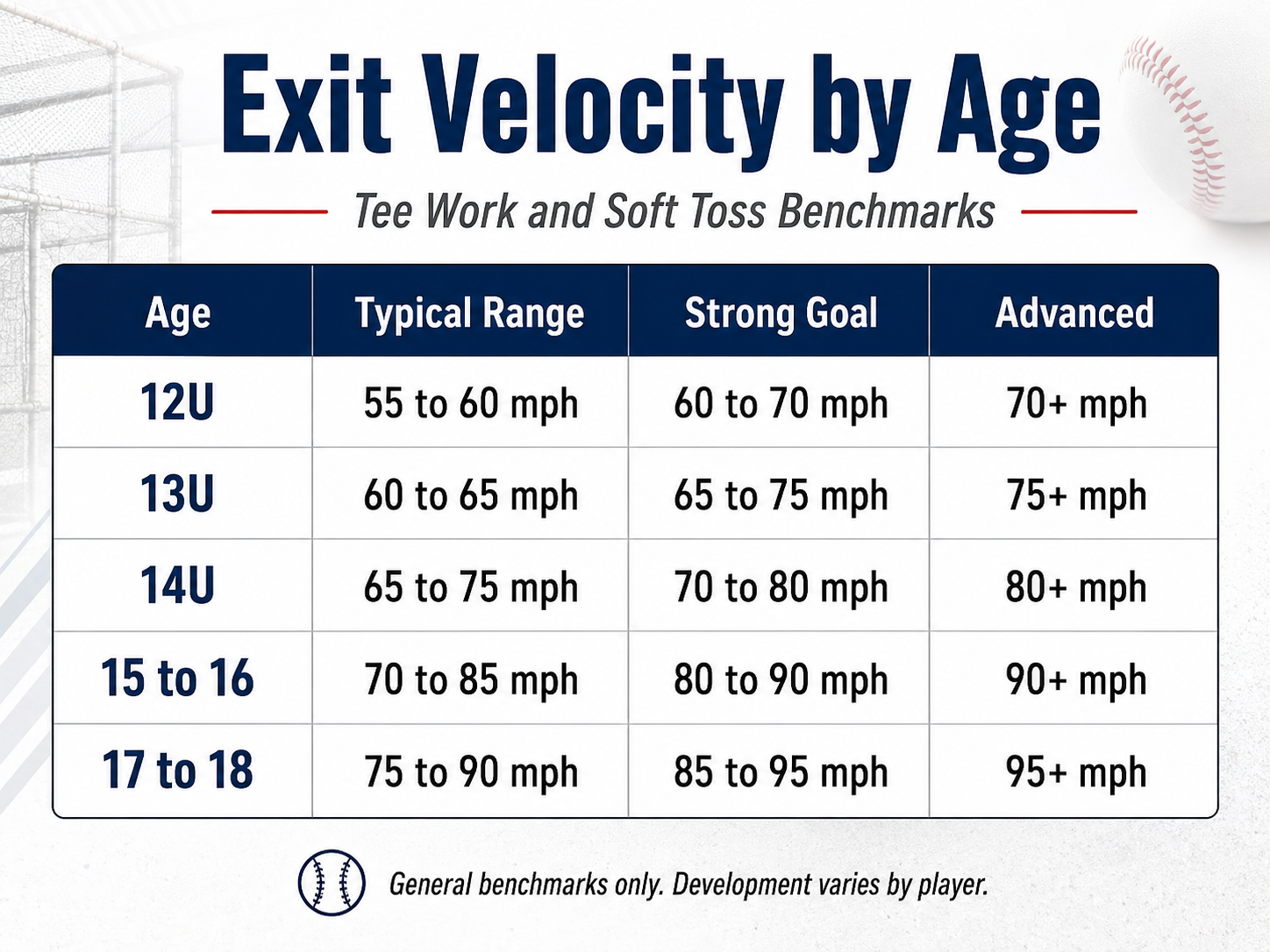
Exit velocity varies a lot by player, especially in youth baseball. Size, strength, coordination, bat type, training history, and physical maturity all play a role. These numbers should be used as general benchmarks, not as hard labels for where a player “should” be.
For tee work and soft toss, a practical reference range looks like this:
Exit velocity by age
These ranges are meant to give parents and players context. They are not meant to discourage anyone. A player who is below the typical range may simply need more strength, better sequencing, better contact quality, or more time to physically mature. A player who is above the range still needs to learn how to control the barrel, use the whole field, and produce that contact in game situations.
The better question is not always, “Is this number good for my age?” A better question is, “Can we improve this number while also improving the swing?”
What kind of growth should players expect?
A reasonable expectation for many players is about 3 to 5 mph of exit velocity growth per year through the teen years, although development is rarely that clean. Some players make a bigger jump during a growth spurt. Others grow first, lose some coordination for a while, and then improve once their body catches up.
For players 12 to 14, exit velocity often improves through better contact quality, better lower half sequence, improved posture, and a more consistent barrel path. At this age, the goal is not to force a player into an adult swing. The goal is to help them move better, stay balanced, and learn how to square the ball up more often.
For older players, strength and bat speed become bigger parts of the equation, but the same basic rule still applies. More bat speed only helps if the player can deliver the barrel to the ball. A stronger player who misses the barrel or loses posture will not get the full benefit of that strength.
How the baseline guides cage work
The baseline gives us direction. If a player has a solid peak exit velocity but a much lower average, we may need to work on consistency. If the exit velocity is improving but the ball is being hit too high or too low, we may need to look at contact point and swing path. If a player only hits the ball hard to the pull side, we may need to work on direction and adjustability.
This is where HitTrax becomes more than a screen in the cage. It helps connect the training plan to the player in front of us.
After the baseline, cage work can be built around specific goals. A player may spend time working on clean contact through the middle of the field, then move into rounds focused on harder contact, then finish with more game like swings. The structure depends on what the baseline shows.
We do not want players staring at the numbers after every swing or trying to muscle every ball. The point is to use the data, make adjustments, and then let the player compete. Over time, we can retest and see whether the work is showing up in measurable ways.
Why this matters for players and parents
One of the hardest parts of youth development is knowing whether a player is actually improving. A swing may look better, but the contact may not be better. A player may feel stronger, but the ball may not be coming off the bat any harder. A player may have one great round in the cage, but struggle to repeat it the next week.
A HitTrax baseline helps make development more visible. It gives parents a clearer picture of where their player is starting, and it gives players a way to see progress that is not based only on hits in games. That matters because game results can be messy. A player can hit a ball hard right at someone, or get a hit on weak contact. The cage gives us a controlled environment where we can focus on the quality of the swing and the quality of contact.
Exit velocity should not replace coaching, approach, or feel. It should support them. When used the right way, it helps players understand their swing better and gives them a more honest view of their progress.
At Vicarious Athletics, that is why we start with a baseline. We want players to know where they are, understand what they are working on, and then use their cage time with purpose.

The Off Season Hitting Plan
Coach teaching at batting cages
How to use batting cages in the off season without wasting reps or wearing your swing out
If you are serious about getting better at hitting, the off season is where it happens. Not because you are grinding every day, but because you finally have time to build the foundation: cleaner mechanics, better timing, stronger movement, and a repeatable routine you can trust when the season starts.
At Vicarious Athletics, we see a common pattern: players show up in the off season with good intentions, then spend 45 minutes “swinging hard” and leave with fatigue, bad habits, and no clear direction. An off season plan fixes that. It turns cage time into progress you can measure.
Here is a practical, sustainable off season hitting plan you can run for any age group, with small tweaks based on experience level.
First, define the off season goal
In season, you are competing. In the off season, you are building.
Your off season hitting goal should be one of these:
Make your swing more repeatable
Improve contact quality (barrels, line drives, gap contact)
Improve timing (on time for fastballs, adjustable for off speed)
Improve plate approach (swing decisions and plan)
If you try to do everything at once, you will do nothing well. Pick one main goal and one secondary goal per month.
The biggest mistake: too much “game speed” too soon
Max intent swings every session, at high velocity, for weeks on end, can burn players out mentally and physically. In the off season, most reps should be controlled and purposeful.
Think of it like strength training. You do not max out every day. You build capacity, then layer intensity.
The 12 week off season plan (simple, effective)
Phase 1: Foundation (Weeks 1–4)
Theme: mechanics, movement, contact quality
2 sessions per week is enough for most youth players.
Session structure:
Warm up (5–8 minutes)
Dynamic movement, band work, a few easy dry swings.Tee work (10 minutes)
Goal: clean contact, consistent bat path.
Focus cue examples: “See it, hit it, finish balanced.”Front toss or soft toss (10–12 minutes)
Goal: rhythm and timing, line drive intent.Cage work, moderate speed (10–15 minutes)
Goal: repeatability.
Pick one zone focus per round: middle away, middle in, etc.Short review (2 minutes)
One thing that improved, one cue for next session.
What to track:
Line drives per round
How often you finish balanced
Miss pattern (under, over, jammed, late)
Phase 2: Build and Adjust (Weeks 5–8)
Theme: timing, adjustability, controlled intensity
2–3 sessions per week depending on age and recovery.
Session structure:
Keep tee work but shorten it.
Add “timing rounds” in the cage:
Round A: early, on time for fastball
Round B: intentionally let the ball travel (opposite field focus)
Add situational rounds:
hit behind runner
hard ground ball middle
line drive to gap
What to track:
Hard contact percentage (your best estimate is fine)
Opposite field line drives
How quickly you can self correct after a miss
Phase 3: Game Prep (Weeks 9–12)
Theme: higher intent, decision making, game like reps
This is where velocity goes up, but reps stay structured.
Session structure:
Short tee (5 minutes)
Short toss (5–8 minutes)
Machine or higher velocity cage work (15–20 minutes)
At bat rounds (10 minutes)
Simulate counts: 0–0, 1–1, 2 strikes.
Your goal is quality at bats, not just hits.
What to track:
Quality at bat rate (did you stick to a plan)
Two strike contact
First pitch decision discipline
The “right amount” of cage work by age
This is a general guide. The best plan is the one your body and schedule can sustain.
Ages 7–10: 1–2 cage sessions per week, short and fun
Ages 11–13: 2 sessions per week, add timing and approach
Ages 14–18: 2–3 sessions per week depending on lifting, team work, and recovery
More is not better if it turns into sloppy reps.
What a great cage session looks like (the Vicarious Athletics template)
A strong session is not 200 swings. It is 60–90 high quality swings with a purpose.
Our default round setup:
Round 1: timing, up the middle
Round 2: pull side line drives
Round 3: opposite field line drives
Round 4: situation or weakness focus
Round 5: compete, game like at bats
If you leave the cage with one clear improvement and one clear next step, the session worked.
Strength work and recovery are part of hitting
Off season hitting improves faster when the body supports it.
Priorities:
hips and core strength
shoulder stability
mobility, especially hips and thoracic spine
sleep and nutrition
If your swing breaks down late in sessions, that is often a strength and stamina issue, not just “mechanics.”
The easiest way to stay consistent: schedule a routine
Pick days and times you can actually keep.
Example week:
Tuesday: cages, foundation work
Thursday: cages, timing and approach
Saturday: optional, game prep rounds or a short fun session
Consistency beats intensity every time.
Want a plan built for your player?
At Vicarious Athletics, we can help you set up a simple off season program that matches your age, goals, and schedule, so you start the season sharper, more confident, and ready to compete.
If you want help mapping your next 12 weeks, come in for a session and we will build it around what you need most: contact, timing, approach, or power.

Common Youth Hitting Faults, and How Parents and Rec Ball Coaches Can Help Fix Them
If you spend enough time around youth baseball, you start to notice the same hitting issues show up again and again. A young hitter looks off balance, drifts forward too early, swings around the ball, or finishes with their head flying away from contact. Most of the time, the problem is not effort. It is that one part of the swing is breaking down, and that issue is throwing off everything else.
The good news is that parents and rec ball coaches do not need to turn every practice into a private hitting lesson. You do not need a complicated vocabulary or a professional background to help young hitters improve. In many cases, the best coaching comes from recognizing a few common faults, keeping the language simple, and giving players better reps.
steps to a great baseball swing!
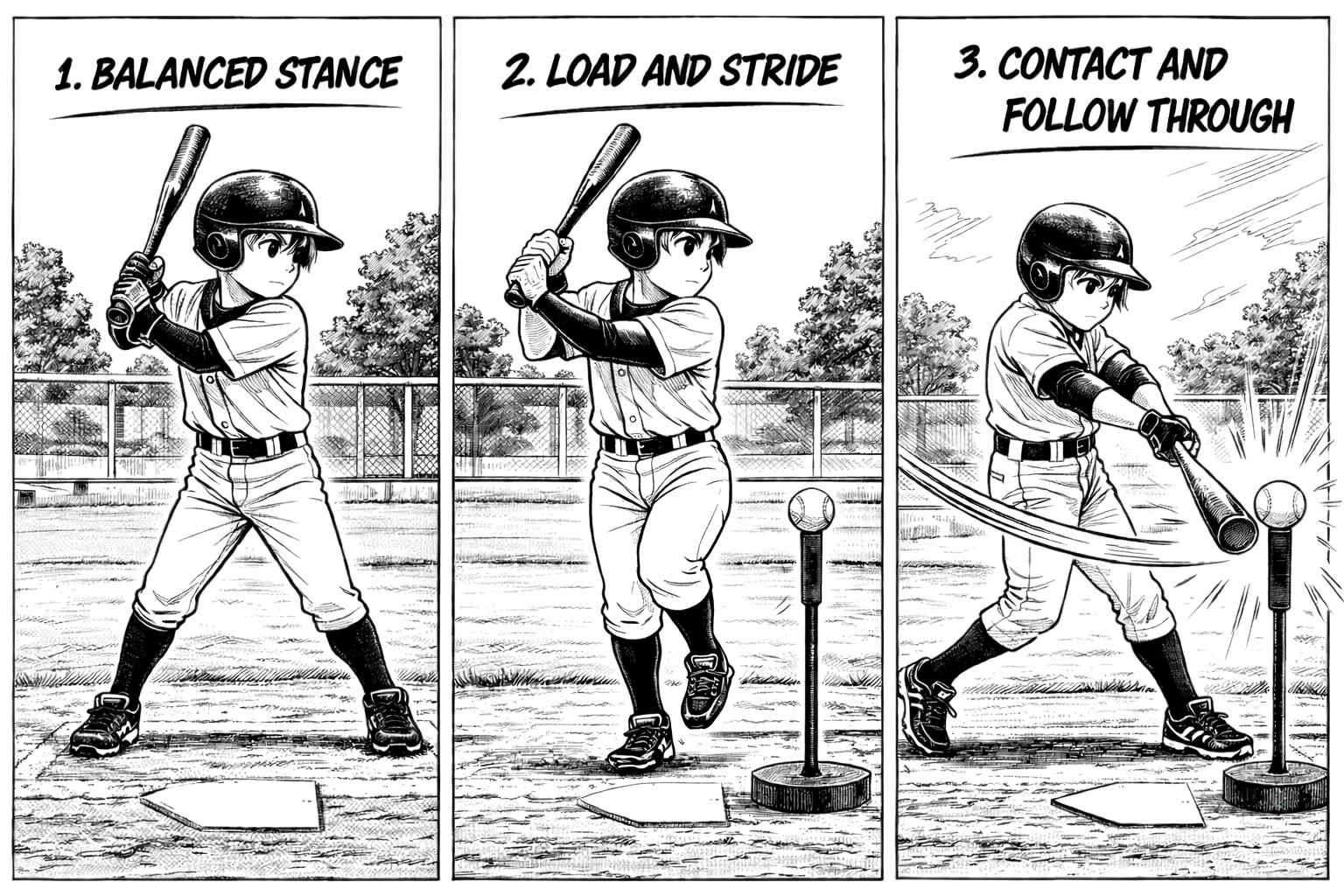
1. Start with balance
Before a hitter can do anything well, they need to start from a balanced position. If the stance is unstable, the swing usually becomes a recovery move instead of a controlled athletic movement.
A young hitter should look comfortable, athletic, and ready to move. Their head should be steady, their eyes should be level, and their body should not look twisted or tense before the pitch is even on the way.
For most youth players, simple is better. A balanced, even stance gives them a better chance to see the ball clearly, stay under control, and move efficiently into the swing.
If a hitter looks like they are falling in or drifting around before the pitch, start there. A better stance can clean up a lot of problems on its own.
2. Teach hitters to load, not just step
One of the most common mistakes in youth baseball is teaching hitters to just step and swing. That usually leads to too much forward movement, too much head drift, and poor timing.
A hitter needs to gather before they go. That means loading into the back side, controlling the move forward, and getting the front foot down in a way that keeps the body ready to fire.
Think of it this way: good hitters do not just go forward; they create tension first, then release it.
A helpful cue for young players is: “Load, then go.”
When hitters do this well, you will usually see:
better rhythm
better timing
less lunging
more controlled swings
When they do it poorly, you will often see:
the head drifting forward
the front side collapsing
weak contact
swings that feel rushed
3. Watch the hands and swing path
A lot of young hitters swing around the baseball instead of through it. Their hands drift away from the body, the barrel gets long, and the swing becomes more of a sweep than a direct path.
This usually creates several problems at once. The hitter gets jammed more easily, struggles to stay in the zone very long, and tends to become overly pull conscious. Even if they make contact, the quality of contact often suffers.
Young hitters usually do better when the hands work tighter and more directly to the ball.
Good cues include:
“Keep the hands tight”
“Take the knob toward the ball”
“Short to it, long through it”
That last one works especially well with rec players because it keeps the idea simple. You want a compact move into contact, then extension through contact.
4. Stop teaching high back elbow as a cure all
A lot of young players get taught to lift the back elbow high because adults think it will help them stay on top of the ball. In reality, this often creates more problems than it solves.
When the back elbow starts too high, it often drops hard as the swing begins. That can cause the front shoulder to lift, the barrel to dip, and the swing to work underneath the baseball.
For most youth hitters, a more relaxed setup works better. The elbows should not look stiff or exaggerated. They should look natural, athletic, and ready to move together with the rest of the body.
If a player is constantly getting under the ball, this is one of the first things worth checking.
5. Help hitters avoid the loop
Many young hitters develop a loopy swing path. The barrel drops too early, the hands lose direction, and the bat enters the zone from underneath. That often leads to weak fly balls, pop ups, and a lot of swings and misses.
One of the best tools for fixing this is the tee.
Tee work gives players a chance to slow down and focus on their path to contact. Instead of reacting to velocity, they can work on staying connected, keeping the barrel above the hands, and driving line drives with better direction.
But tee work only helps if it is done with purpose.
A few things to watch during tee work:
is the hitter staying balanced
are the hands working directly to the ball
is the barrel staying above the hands
are they producing line drive contact instead of lifting everything
Sometimes a small number of focused swings is more valuable than a large number of sloppy ones.
6. Use the whole body, not just the upper half
Another common youth issue is a swing that is all upper body. The hitter throws the hands, but the legs and hips do very little to support the movement. That usually results in a weaker, less connected swing.
Good hitting uses the ground. The lower half helps create stability, rotation, and force. One easy thing for coaches to watch is the back foot. It should pivot naturally as the swing turns through the ball.
If the back foot stays stuck, or if the hitter looks frozen from the waist down, there is a good chance they are not using the body efficiently.
A young hitter does not need to think about every body segment. They just need to learn that the swing is not only about the hands. The whole body has to work together.
7. Keep both hands through contact, and keep the head on the ball
Two more youth faults show up all the time.
The first is letting go with the top hand too early. Young hitters sometimes do this because they are trying to muscle the ball or because they are copying older players without understanding when the release actually happens. When the top hand comes off too soon, the hitter usually loses strength and control through contact.
The second is pulling the head away from the ball. This happens when the player is trying to see where the ball went before they have actually finished the swing. It is one of the fastest ways to reduce clean contact.
Simple reminders help here:
“See the ball to contact”
“Stay through it”
“Finish before you look”
For rec players, these cues are usually enough.
8. Keep the coaching simple
One of the biggest mistakes adults make is giving young hitters too many thoughts at once. If a player hears six corrections in one round, they usually do not improve, they just get overwhelmed.
Try this approach instead:
Identify the biggest problem.
Give one simple cue.
Let the player get a few focused reps.
Reassess.
That is usually more effective than turning every swing into a full breakdown.
Final thought
Helping young hitters does not require perfection. It requires observation, patience, and clear language. Most kids will improve when the adults around them slow the game down, simplify the message, and reinforce good movement patterns over time.
If you can help a player stay balanced, load under control, swing more directly to the ball, use the lower half, and keep the head through contact, you are giving them a strong foundation that will carry well beyond rec baseball.

Reducing Arm Injuries in Youth Baseball: How to Chase Development Without Chasing Damage
Youth baseball has changed. Velocity is celebrated earlier; radar guns show up at younger ages; social media highlights the hardest throw, not the healthiest season. At the same time, clinicians and sports medicine groups keep seeing the same pattern, more elbow and shoulder problems tied to workload, fatigue, and year round throwing.
Youth baseball has changed. Velocity is celebrated earlier; radar guns show up at younger ages; social media highlights the hardest throw, not the healthiest season. At the same time, clinicians and sports medicine groups keep seeing the same pattern, more elbow and shoulder problems tied to workload, fatigue, and year round throwing.
The good news is that most of the biggest risk factors are controllable. If we treat arm health like a training goal, not an afterthought, kids can develop safely and still build real velocity over time.
The real issue is not velocity alone, it is how kids are asked to get it
Higher velocity can increase stress on the arm, but the bigger problem is usually the path taken to get there: throwing too often, too tired, too many months in a row, sometimes for multiple teams, plus extra bullpens, showcases, and lessons layered on top.
MLB’s Pitch Smart program focuses on workload limits and rest because pitch counts are one of the most practical ways to reduce pitching with fatigue.
The American Sports Medicine Institute has also emphasized overuse as a primary risk factor for injury in adolescent pitchers, with mechanics and physical conditioning contributing as well.
Start with the “Big Four” rules that prevent most problems
1) Track total workload, not just game pitches
Game pitch counts matter, but so do warmups, bullpen sessions, and extra throwing days. Little League rules include required rest based on pitches thrown, and they prohibit pitching in three consecutive days, which is a good foundation for fatigue management.
Parent and coach action: keep a simple shared log that includes
game pitches
bullpen pitches
warmup pitches
days thrown hard
any pain, tightness, or “dead arm” notes
2) Follow age appropriate pitch counts and required rest
Pitch Smart provides age group pitching guidelines, including pitch count limits, required rest, and recommendations like taking multiple months off from throwing each year.
Even if your league uses a different system, the principle is the same: fatigue is the enemy; rest is part of training.
3) Avoid year round throwing
One of the most consistent themes in injury prevention is that year round throwing raises risk, especially when paired with high intensity. Reviews of youth throwing injuries continue to highlight workload, fatigue, and overuse as central drivers of injury.
Practical guideline: build an “off season” for throwing, then ramp back up gradually.
4) Pain is not normal, do not throw through it
This sounds obvious, but it is the rule that gets broken most. If a kid needs ibuprofen to get through a weekend, something is wrong.
Simple policy: if pain changes mechanics, changes effort level, or lingers after throwing, stop and get evaluated.
Warning signs that a young arm is in the danger zone
Watch for patterns, not one off soreness.
soreness that lasts more than 24 to 48 hours after pitching
loss of control or sudden drop in performance late in outings
a “heavy” arm, stiffness, or unusual tightness before throwing
changing mechanics to protect discomfort
needing longer and longer warmups to feel normal
If those show up, the right move is not “push through,” it is reduce load, increase recovery, and reassess.
Smarter ways to build velocity, without gambling with the elbow
Velocity is a product of the whole body, not just the arm. A 2024 review on throwing injuries and prevention strategies emphasizes the importance of sequencing, mechanics, and structured training approaches in youth throwers.
What tends to help, safely, when done correctly
strength and mobility, especially hips, trunk, shoulder blade control
sprinting, jumping, general athleticism, kids need horsepower
gradual long toss and throwing progressions, not sudden spikes in intensity
mechanics work focused on efficiency, not forcing max effort every rep
clear limits on “max intent” days, most throws should not be max effort
What tends to create trouble
multiple high intensity throwing days per week, stacked across teams
constant showcases, constant bullpens, constant “prove it” outings
chasing velo with fatigue, because the radar gun is out
skipping recovery, sleep, nutrition, and general strength work
The parent factor, the most underrated safety tool
One of the biggest gaps in youth baseball is not knowledge, it is coordination. A child might throw for school ball, travel, lessons, and then do extra on their own. Nobody sees the whole workload unless a parent does.
A Sports Medicine Update article in 2025 noted research suggesting youth players are less likely to be injured when parents know and follow Pitch Smart guidelines.
Your job as a parent is to be the workload manager
ask every coach how your child will be used this week
share pitch counts and rest days across teams
protect off days, protect sleep, protect the long view
choose development over constant exposure
How we think about arm safety in a batting cage facility
A batting cage is not a pitching mound, but arm health still matters, especially if players are also throwing regularly and training year round. Our approach is simple:
we encourage sustainable training plans, not daily max intensity cycles
we support structured warmups and recovery habits
we help families think in seasons, not in endless weeks
we prefer measurable progress, mobility, timing, contact quality, over constant “go harder” sessions
If you ever want help building a safe training rhythm around your team schedule, we can help you map it out.
Quick disclaimer, because it matters
This post is educational, not medical advice. If a player has pain, numbness, persistent soreness, or loss of function, stop throwing and consult a qualified sports medicine professional.

Parents matter more than the perfect swing
Parents cheering for baseball
In youth baseball, coaches teach mechanics. Parents shape the environment that decides whether a kid wants to keep playing.
That environment is built in small moments: the car ride home, what gets praised, how mistakes are handled, how much rest is protected, and whether baseball feels like a place where effort is safe.
Research and youth-sports organizations consistently point to the same theme: when adults over-pressure, over-schedule, or turn every game into an evaluation, kids are more likely to lose motivation and drop out.
If you’re raising a player in San Diego County (where baseball culture is strong and opportunities are everywhere), the best “development plan” is often less about more lessons and more about the tone you set around the sport.
The parent’s job description
1) Be the “safe place,” not the extra coach
Kids already have coaches. What they need from parents is emotional safety: support regardless of the box score.
The American Academy of Child & Adolescent Psychiatry highlights that parents help kids get the most out of sports by providing emotional support, positive feedback, and modeling sportsmanship.
What this looks like in real life
Cheering effort, hustle, and courage (not only outcomes)
Avoiding “fixing” mid-game from the stands
Letting the coach coach, and letting the kid be a kid
2) Protect rest and keep the calendar sane
A major driver of burnout is when sports stop having an “off switch.” The Aspen Institute Project Play has documented how intense youth sports can be on families’ time and expectations.
A practical parent rule: if your child never gets a true mental break from baseball, it will eventually feel like work.
Parent checklist
At least one full day each week with no organized baseball
Build “light weeks” into the season (especially after tournaments)
If your kid is always sore or always anxious, the schedule is too heavy
3) Build a growth mindset at home
The Positive Coaching Alliance emphasizes teaching athletes to treat mistakes as information and improvement as a process.
Translate that into parent language
Replace “You struck out” with “What did you learn?”
Replace “Be perfect” with “Make one adjustment”
Replace “Don’t mess up” with “Compete, one pitch at a time”
The car ride rule: how to talk after games without creating pressure
If you want one habit that protects your child’s love of the game, it’s this:
After games, keep it light unless they invite the breakdown.
A great default script:
“I love watching you play.”
“Do you want to talk about the game, or do you want a break?”
“If you want feedback, I can listen first.”
This aligns with research that parent-child communication can influence whether kids stay in sports, and it highlights how many athletes quit youth sports early.
What to avoid (even when you mean well)
Play-by-play critiques
Re-living one error for 20 minutes
Using “we” language (“We didn’t hit today”)
Your kid should leave the field feeling like your relationship is not tied to performance.
Sideline behavior: your child is watching you more than the game
Kids notice:
Your tone with umpires
How you react to errors
Whether you coach from the stands
Whether your body language says “fun” or “stress”
The parent’s role is to make the environment calmer, not hotter.
Try these substitutions:
Instead of instructions: encouragement (“Good hustle,” “Next pitch,” “Stay with it.”)
Instead of frustration: neutral reset (deep breath, clap, short positive phrase)
Instead of arguing: model composure
The message you want your child to absorb is: “It’s safe to try hard things here.”
Development choices parents control (that matter more than batting average)
Let kids “sample” and play other sports
USA Baseball promotes long-term athlete development and age-appropriate pathways, emphasizing that development is a process, not a rush.
Multi-sport movement helps coordination, reduces monotony, and keeps competition fresh.
Choose the right level of challenge
A simple test: is your child mostly experiencing:
manageable challenge,
visible progress,
and some joy?
If the level is too high, every weekend becomes anxiety. Too low, they get bored. Your job is to find the sweet spot.
Define success the right way
At younger ages, success is:
learning to compete
being a great teammate
improving one small thing at a time
wanting to come back tomorrow
Not exposure. Not rankings. Not “playing up” at all costs.
Warning signs your child is burning out (and what to do)
If you’re seeing:
dread before practice
constant negativity or tears around games
recurring aches or “mystery” pain
fear of mistakes
suddenly wanting to quit
Treat it like a signal, not a character flaw.
What helps quickly
Reduce the schedule for 2–3 weeks
Give them more choice and autonomy (“Do you want cages or defense today?”)
Make practice more game-like and less lecture-like
Rebuild confidence with achievable goals
A simple parent plan for a healthy season
Weekly
2–3 baseball touch points (practice, cages, team session)
1–2 unstructured “play” days (wiffle ball, backyard throws, fun competition)
1 full day off from baseball
Monthly
One “reset weekend” with no tournaments
One conversation: “What’s fun right now? What feels stressful?”
Bottom line
Your child’s long-term development isn’t just mechanics. It’s motivation.
If you can be the calm, supportive constant, protect rest, praise growth, and keep baseball connected to joy, you’ll give your kid the best chance to keep playing through high school, and actually love the game when they get there.

How to Coach Kids So They Love Baseball for Life
Practical, research backed coaching habits that help young players improve, stay healthy, and keep their love for the game through high school.
The real goal, before high school
In North County San Diego, baseball and softball can get serious fast. Select teams, private lessons, year round schedules, showcases, pressure to “keep up.” All of that can produce better players, but it can also quietly produce something else, kids who are mentally cooked by 13 or 14.
If you’re a parent or coach of a developing player, your job is bigger than mechanics. Your job is to help a kid build skills and keep the sport emotionally safe, so they want to keep playing when it actually counts, in high school and beyond.
So what does “good coaching” look like when the end goal is a lifelong love of the game?
What burnout looks like in young players
Burnout is not just “being tired.” It often shows up as:
Dreading practice, dragging feet, sudden loss of joy
Irritability, shutdowns, unusually negative self talk
More aches and pains, nagging soreness, repeated “tweaks”
Fear of making mistakes, playing “not to mess up”
Quitting fantasies, “I’m done after this season”
The fix is not to “want it more.” The fix is to coach the whole child, not just the athlete.
Principle 1: Protect rest like it’s part of training
One of the simplest ways to prevent burnout is also one of the most ignored, planned days off.
AAP guidance commonly emphasizes regular time away from organized sport, including at least 1 to 2 days off per week from the sport, and caution around year round, single sport training for kids.
Practical coaching move:
Build your weekly plan so the kid can clearly see rest is normal and expected. Say it out loud.
“We train hard; we rest hard.”
“Off days are how your body and brain get better.”
“If you’re sore in a way that changes your swing or throwing motion, we back off.”
Principle 2: Delay early specialization, keep the athlete versatile
A lot of families specialize early because they feel like they have to. But multiple medical and development focused resources recommend delaying true single sport specialization until later adolescence, and encouraging “sampling” and broad athletic development earlier.
What this means for baseball training:
Even if baseball is your kid’s main sport, you can still coach variety.
Rotate movement patterns, sprint work, jumps, balance, agility
Encourage another sport or seasonal break
Avoid turning every workout into baseball only, baseball always
Principle 3: Praise effort, choices, and growth, not just outcomes
If a kid believes love and approval only show up when they go 3 for 3, the sport becomes a stress machine.
Swap these coaching habits:
Instead of:
“You’re a natural.”
“You’re the best hitter on the team.”
“How could you swing at that?”
Try:
“I love how you competed that at bat.”
“Good adjustment, you stayed through the ball.”
“What did you notice, what will you try next pitch?”
You’re training confidence under pressure, not perfection.
Principle 4: Make practice feel like play, especially for younger kids
Kids fall in love with games, not lectures.
A simple rule:
The younger the athlete, the more practice should resemble a game.
That means:
Short instruction, lots of reps
Competitive mini games, “beat your score” challenges
Stations that keep kids moving
Clear wins that don’t require being “the best”
Even teens need this. They just want the games to be more baseball real.
Principle 5: Teach emotional skills like they are part of baseball skills
High level youth athletes do not quit because they “can’t hit.” They quit because the experience becomes emotionally heavy.
You can train this with simple routines:
A pre at bat reset: breathe, pick a focus, step in
A post failure routine: step out, release it, one cue for next pitch
A team norm: mistakes are feedback, not identity
When kids learn how to handle failure, the sport stops feeling like a threat.
A practice template that builds skill and protects love of the game
Here’s a simple 60 minute batting focused session structure that works for most youth ages when adjusted for difficulty:
1) 5 minutes: arrival win
One easy success drill. Tee contact, soft toss, short bat. Start with confidence.
2) 10 minutes: movement and timing
Rhythm drills, stride timing, load to launch. Keep cues minimal.
3) 25 minutes: game like reps
Front toss or machine with “counts.”
Example: 0 0, 1 1, 2 strikes. Track quality at bats, not just hits.
4) 10 minutes: challenge game
Hit a target, gap points, “move the runner,” compete in pairs.
5) 10 minutes: cool down and reflection
Ask two questions:
“What felt better today?”
“What’s one thing you’ll take into your next game?”
This creates development, autonomy, and a sense of progress, which are core antidotes to burnout.
The parent coach relationship: one conversation that changes everything
If you only take one thing from this post, take this:
Separate support from performance.
When kids feel emotionally safe at home, they can handle pressure on the field.
Try this after games:
“I love watching you play.”
“Do you want feedback, or do you want me to just listen?”
“What felt good today, what do you want to work on next?”
That’s a simple structure that lowers anxiety and keeps the kid engaged.
A quick word about lessons, cages, and “more training”
More training is not automatically better training.
Better training is:
Age appropriate
Consistent, but not constant
Focused on fundamentals and confidence
Measured by long term progress, not week to week stats
That’s also the philosophy we’re building into our soon to open batting cage facility here in North County San Diego: development first, reps with purpose, and an environment that makes kids want to come back.
If you want your player to still love baseball when high school arrives, the path is rarely extreme. It is steady, joyful, and sustainable.

Inside the Cage: Why we built vicarious athletics batting + performance
We built Vicarious Athletics Batting + Performance because there was a clear gap between wanting to train and having the right place to do it.
If you’ve spent any time around baseball in Oceanside, you already know this:
players don’t stop needing reps just because the weather changes, fields are booked, or daylight runs out.
We built Vicarious athletics batting + performance because there was a clear gap between wanting to train and having the right place to do it. Especially in north County san diego
This facility wasn’t designed to be flashy. It was designed to work.
More Than Just Batting Cages
Batting cages are everywhere.
What’s harder to find is a space that actually supports development, consistency, and accountability.
From the start, our goal was to create a place where:
players can get real reps without distractions,
teams can train efficiently without fighting schedules,
and families have a clean, safe, professional environment they can trust.
That’s why our layout is simple and intentional:
full-length cages for machine work,
flexible training space for drills and instruction,
and HitTrax technology for players who want measurable feedback, not guesses.
Every square foot was planned with training in mind.
Why Data Matters (When Used the Right Way)
Technology doesn’t replace coaching.
But when used correctly, it helps players understand what their bodies are actually doing.
HitTrax gives hitters real feedback — exit velocity, launch angle, spray charts — so improvement isn’t based on feel alone. For some players, that means confidence. For others, it means clarity.
And for teams, it means less time guessing and more time adjusting.
We see data as a tool, not a shortcut.
Built for the Local Baseball Community
Vicarious Athletics Batting + Performance is locally owned and operated. We’re involved in local leagues, we know the coaches, and we understand the rhythm of the baseball calendar here.
This facility exists to support:
youth league players learning fundamentals,
travel ball athletes chasing the next level,
high school players preparing for their season,
and teams looking for reliable indoor access.
No gimmicks. No pressure. Just a space to work.
What You’ll Find Here
This blog, Inside the Cage, will be where we share:
training tips and drills,
thoughts on player development,
updates from the facility,
league and team announcements,
and occasional behind-the-scenes looks at how we train.
If you care about getting better — or helping a player get better — you’re in the right place.
Thanks for being part of the community.
We’ll see you in the cage.
— Vicarious athletics batting + performance