
If you spend enough time around youth baseball, you start to notice the same hitting issues show up again and again. A young hitter looks off balance, drifts forward too early, swings around the ball, or finishes with their head flying away from contact. Most of the time, the problem is not effort. It is that one part of the swing is breaking down, and that issue is throwing off everything else.
The good news is that parents and rec ball coaches do not need to turn every practice into a private hitting lesson. You do not need a complicated vocabulary or a professional background to help young hitters improve. In many cases, the best coaching comes from recognizing a few common faults, keeping the language simple, and giving players better reps.
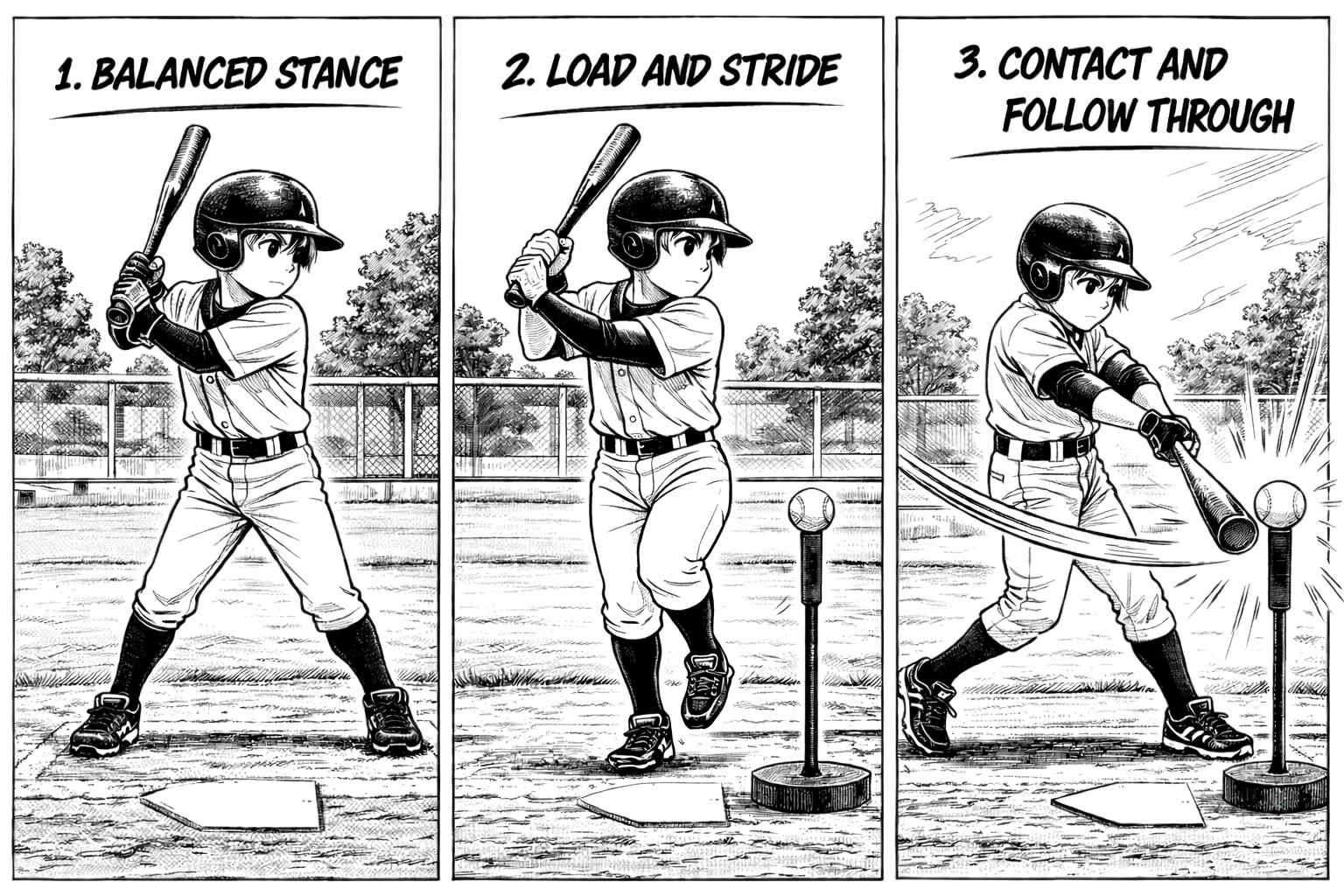
steps to a great baseball swing!
1. Start with balance
Before a hitter can do anything well, they need to start from a balanced position. If the stance is unstable, the swing usually becomes a recovery move instead of a controlled athletic movement.
A young hitter should look comfortable, athletic, and ready to move. Their head should be steady, their eyes should be level, and their body should not look twisted or tense before the pitch is even on the way.
For most youth players, simple is better. A balanced, even stance gives them a better chance to see the ball clearly, stay under control, and move efficiently into the swing.
If a hitter looks like they are falling in or drifting around before the pitch, start there. A better stance can clean up a lot of problems on its own.
2. Teach hitters to load, not just step
One of the most common mistakes in youth baseball is teaching hitters to just step and swing. That usually leads to too much forward movement, too much head drift, and poor timing.
A hitter needs to gather before they go. That means loading into the back side, controlling the move forward, and getting the front foot down in a way that keeps the body ready to fire.
Think of it this way: good hitters do not just go forward; they create tension first, then release it.
A helpful cue for young players is: “Load, then go.”
When hitters do this well, you will usually see:
better rhythm
better timing
less lunging
more controlled swings
When they do it poorly, you will often see:
the head drifting forward
the front side collapsing
weak contact
swings that feel rushed
3. Watch the hands and swing path
A lot of young hitters swing around the baseball instead of through it. Their hands drift away from the body, the barrel gets long, and the swing becomes more of a sweep than a direct path.
This usually creates several problems at once. The hitter gets jammed more easily, struggles to stay in the zone very long, and tends to become overly pull conscious. Even if they make contact, the quality of contact often suffers.
Young hitters usually do better when the hands work tighter and more directly to the ball.
Good cues include:
“Keep the hands tight”
“Take the knob toward the ball”
“Short to it, long through it”
That last one works especially well with rec players because it keeps the idea simple. You want a compact move into contact, then extension through contact.
4. Stop teaching high back elbow as a cure all
A lot of young players get taught to lift the back elbow high because adults think it will help them stay on top of the ball. In reality, this often creates more problems than it solves.
When the back elbow starts too high, it often drops hard as the swing begins. That can cause the front shoulder to lift, the barrel to dip, and the swing to work underneath the baseball.
For most youth hitters, a more relaxed setup works better. The elbows should not look stiff or exaggerated. They should look natural, athletic, and ready to move together with the rest of the body.
If a player is constantly getting under the ball, this is one of the first things worth checking.
5. Help hitters avoid the loop
Many young hitters develop a loopy swing path. The barrel drops too early, the hands lose direction, and the bat enters the zone from underneath. That often leads to weak fly balls, pop ups, and a lot of swings and misses.
One of the best tools for fixing this is the tee.
Tee work gives players a chance to slow down and focus on their path to contact. Instead of reacting to velocity, they can work on staying connected, keeping the barrel above the hands, and driving line drives with better direction.
But tee work only helps if it is done with purpose.
A few things to watch during tee work:
is the hitter staying balanced
are the hands working directly to the ball
is the barrel staying above the hands
are they producing line drive contact instead of lifting everything
Sometimes a small number of focused swings is more valuable than a large number of sloppy ones.
6. Use the whole body, not just the upper half
Another common youth issue is a swing that is all upper body. The hitter throws the hands, but the legs and hips do very little to support the movement. That usually results in a weaker, less connected swing.
Good hitting uses the ground. The lower half helps create stability, rotation, and force. One easy thing for coaches to watch is the back foot. It should pivot naturally as the swing turns through the ball.
If the back foot stays stuck, or if the hitter looks frozen from the waist down, there is a good chance they are not using the body efficiently.
A young hitter does not need to think about every body segment. They just need to learn that the swing is not only about the hands. The whole body has to work together.
7. Keep both hands through contact, and keep the head on the ball
Two more youth faults show up all the time.
The first is letting go with the top hand too early. Young hitters sometimes do this because they are trying to muscle the ball or because they are copying older players without understanding when the release actually happens. When the top hand comes off too soon, the hitter usually loses strength and control through contact.
The second is pulling the head away from the ball. This happens when the player is trying to see where the ball went before they have actually finished the swing. It is one of the fastest ways to reduce clean contact.
Simple reminders help here:
“See the ball to contact”
“Stay through it”
“Finish before you look”
For rec players, these cues are usually enough.
8. Keep the coaching simple
One of the biggest mistakes adults make is giving young hitters too many thoughts at once. If a player hears six corrections in one round, they usually do not improve, they just get overwhelmed.
Try this approach instead:
Identify the biggest problem.
Give one simple cue.
Let the player get a few focused reps.
Reassess.
That is usually more effective than turning every swing into a full breakdown.
Final thought
Helping young hitters does not require perfection. It requires observation, patience, and clear language. Most kids will improve when the adults around them slow the game down, simplify the message, and reinforce good movement patterns over time.
If you can help a player stay balanced, load under control, swing more directly to the ball, use the lower half, and keep the head through contact, you are giving them a strong foundation that will carry well beyond rec baseball.
