
A kid can hit well when they’re younger even if they start their swing with their shoulders. Against slower pitching, they have time to get the barrel around. Then the pitching gets faster, and a swing that used to get to the ball on time starts getting there late.
I’ve seen kids quit baseball after age 12 because they felt like they couldn’t hit anymore. In the swings I was seeing, the shoulders still started the turn. That had worked for them when the ball was coming in slower. Once the pitching picked up, they had trouble getting the barrel to the ball in time.
That’s why I teach the kinetic chain early. When the legs, hips, and torso help get the bat moving, the hands can get the barrel to the ball sooner. That’s part of what coaches mean when they talk about quick hands. If a hitter can get the barrel there in less time, they have a little more time to see the pitch before committing to the swing. That extra time matters more as the pitching gets faster.
How the swing builds speed
The kinetic chain is how the different parts of your body work together to move the bat. The legs help get the hips turning. The torso speeds up as it follows the hips. The arms and hands bring the barrel through as the chest comes around. Those movements overlap, and each contributes to getting the barrel up to speed.
When I explain this to kids at Vicarious Athletics, I ask them to imagine a string of firecrackers. The biggest explosion goes off at your butt as your back hip starts to turn. Your front leg braces, your front hip counter-rotates, and your hips get ahead of your shoulders, loading your back and core. Then your torso catches up and brings the barrel through the ball. Each burst of power sets up the next one, and that’s how the swing builds speed.
How the swing loads the back and core
Most kids come into the cage wearing shorts, so I point to the side pocket to show them what their hips are doing. As the pocket starts to come around, the chest is still turned more sideways. For a moment, the hips and shoulders are facing slightly different directions. That difference is what coaches mean by hip-shoulder separation.
The separation grows briefly as the hips get ahead of the shoulders. You can feel a little of what that means without a bat. Get into your batting stance and make a small turn with your hips. Let the front of your shirt stay sideways for a moment. You may feel tension through the sides of your abdomen and around your back. That’s the part I’m talking about when I tell a kid to load their back and core.
How the torso catches up
Once the hips get ahead, the torso speeds up and starts to close the gap. As the barrel meets the ball, I want the hitter to feel their hips and torso coming through together. The load and the turn happen as part of one continuous swing.
When a kid tries to catch up by pulling their shoulders around, that’s often when I see the back shoulder and hands drop. The cue I give them is “Relax your shoulders and swing with your torso.” I want them to feel the turn through their middle and let their shoulders come around with it.
Where young hitters break the chain
Most of the young hitters I work with open their shoulders too soon. Sometimes the chest starts turning before I see the side pocket move. Sometimes the pocket and the front of the shirt turn together. Either way, the hips have little chance to get ahead. There’s less separation, and the hitter misses part of the chance to load the muscles around the trunk and use them in the swing. That can leave more of the job of getting the barrel up to speed to the arms and hands.
This shows up in research on young hitters, too. In one study that followed youth baseball players over three seasons, the younger hitters tended to turn their upper bodies earlier as they moved into the swing. The older players showed more separation between the hips and upper body as the front foot landed and the swing began.
Here’s what that can look like in the cage. A kid takes a good swing off the tee, then sees a ball coming in front toss and immediately turns their chest to go after it. With the ball moving, they rush the turn and lose that moment when the hips could get ahead. The side pocket can help you see where the timing changed. Did it start the turn, or did it come around with the shirt?
What to watch at the cage
Start with a few easy swings off a tee. From outside the cage, record from the side where you can see the pocket and the front of the shirt. Watch one swing together in slow motion. Find the moment the pocket starts to come around. Where is the chest at that point? Then play it forward and watch how the chest comes around as the barrel approaches the ball.
Once your player can see it, give them one thing to try. If the hips and chest start together, try “Let me see that pocket turn first.” If the hips get ahead and the hitter tries to pull the shoulders through, try “Relax your shoulders and swing with your torso.” Give them a few swings at an easy pace and ask what they felt. Then go back to front toss and see if they can find that same feeling with the ball moving.
Two drills to practice at home
These are the two drills I use to teach this part of the swing. One lets the hitter feel the separation and swing from it. The other lets them get used to turning their hips while their hands stay back.
Hold and release off a tee
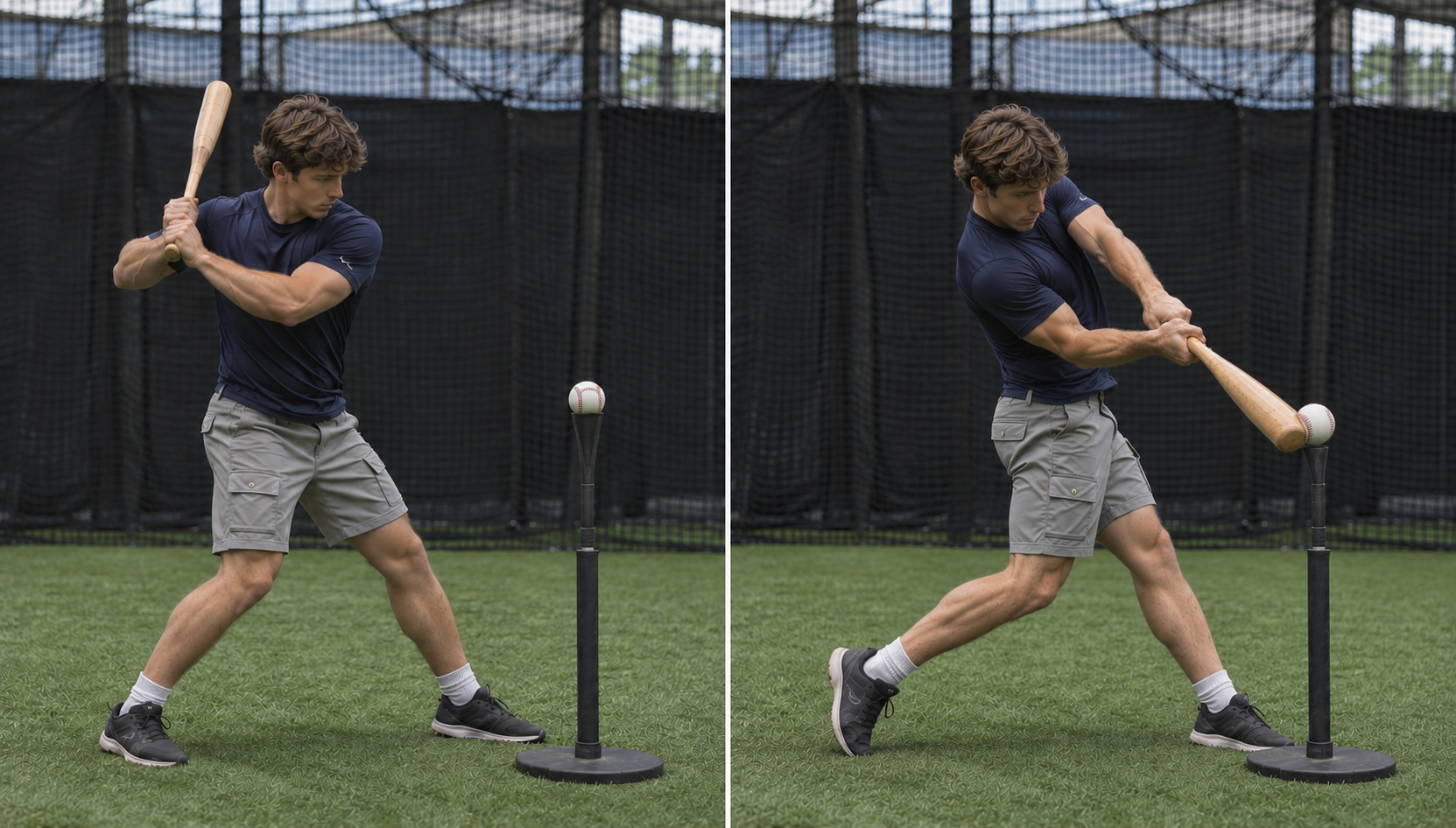
Set up a tee and hitting net with room for a full swing. Start where you’d be at the end of your stride. Plant your front foot, extend your front leg, and turn your back leg inward.
From there, turn your back shoulder away from your front hip until you feel tension through your back and core. Hold that position for three seconds. Then relax your shoulders and let your torso turn as you release that tension and swing through the ball.
The hold gives you time to feel what the back and core are doing. In a regular swing, that same stretch and release happen in one continuous motion.
Turn your hips with your hands back
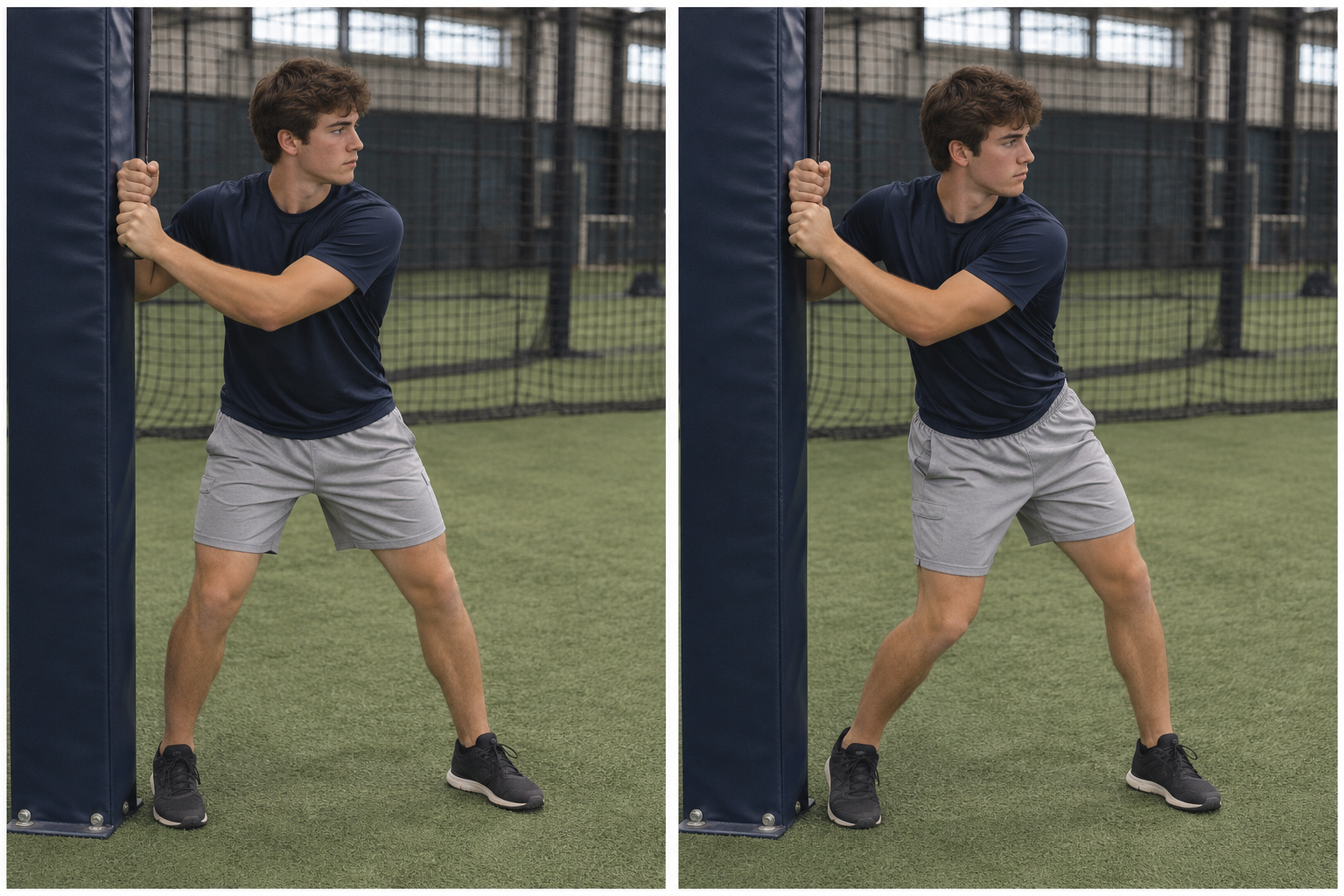
Set up in a relaxed hitting stance with no bat. Take a light grip on something fixed behind you, like a sturdy post or doorframe. While you’re holding on, turn your hips as you would to start the swing. Your hands stay where they are while the side pocket starts to come around. Keep the turn small enough that you can stay relaxed and feel the separation through your back.
Hold for three seconds, then go back to your starting stance. I have hitters repeat this 20 times a day until the position starts to feel familiar.
Both drills give kids a chance to feel how one part of the swing powers the next. I like to teach that while kids are still hitting well. Once the pitching gets faster, they’ll have less time to get the barrel to the ball. If they already know how to get their hips and torso working together, they have a better chance of getting there on time.
In Part 2, I’ll take the kinetic chain to the mound. We’ll follow a pitch from the stride through ball release and look at what parents can watch for in a young pitcher’s delivery.
Sources
Kidokoro, Matsuzaki, and Akagi (2019). Acceptable timing error at ball-bat impact for different pitches and its implications for baseball skills.
Tsutsui et al. (2023). Longitudinal changes in youth baseball batting based on body rotation and separation.
Welch et al. (1995). Hitting a baseball: a biomechanical description.
