
Exit velocity has become one of the more common hitting metrics in baseball, but for youth players it can be easy to misunderstand. Parents hear the number, players start chasing the number, and suddenly every swing becomes about trying to hit the ball as hard as possible. That is not really the point.
At Vicarious Athletics, we use HitTrax exit velocity testing as a developmental tool. For players 12 and up, it gives us a way to establish a baseline, track progress, and build cage work around something more useful than guesswork. The number matters, but only when it is connected to the swing, the quality of contact, and the player’s ability to repeat good movement.
What exit velocity actually tells us
Exit velocity is the speed of the ball immediately after it comes off the bat. In simple terms, it tells us how hard a player hit the ball.
That information is useful, especially as players get older and start developing more strength. A harder hit ball gives a hitter a better chance to produce offense, but exit velocity by itself does not tell the whole story. A player can hit a ball hard into the ground, hit a high popup with a decent number, or square a ball up on a line with a lower number that is actually more useful in a game.
That is why we do not treat exit velocity as the only thing that matters. We look at it alongside launch angle, direction, consistency, and the player’s mechanics. A good baseline is not just the hardest ball a player can hit once. It is a look at how often they can produce quality contact with a swing they can repeat.
Why we start tracking around age 12
Around 12 years old, players usually begin entering a different stage of development. Some are starting to get stronger. Some are growing quickly and trying to adjust to a body that feels different every few months. Some players are still small but coordinated, while others are bigger and stronger but not always in control of their movement.
That range is exactly why a baseline helps.
Without measured data, it is easy to rely only on what a swing looks like or how hard contact sounds in the cage. Those things matter, but they can also be misleading. HitTrax gives players, parents, and coaches a more objective way to see where a hitter is starting and whether the work is actually moving them forward.
For a 12 or 13 year old, the value is not in comparing them to every other player their age. The value is in comparing them to themselves over time.
How we establish an exit velocity baseline
In our HitTrax cage, we use tee work and soft toss to establish exit velocity baselines. We do that because both settings give us a cleaner look at the swing.
Tee work removes most of the timing variable. The player can focus on posture, sequence, barrel path, and contact quality. Soft toss adds a little more rhythm and movement while still keeping the environment controlled. Together, they give us a practical view of how the ball is coming off the bat without turning the session into a test of whether the player can time a machine.
That consistency matters. If we measure a player one way in January and a completely different way in March, the comparison is not very useful. By using the same setup for baseline testing, we can track progress with more confidence.
A typical baseline may include average exit velocity, peak exit velocity, hard hit percentage, launch angle, spray direction, distance, and video of the swing. We also pay attention to the player’s setup, bat, contact quality, and whether the swing holds up over multiple reps.
Average exit velocity by age
Exit velocity varies a lot by player, especially in youth baseball. Size, strength, coordination, bat type, training history, and physical maturity all play a role. These numbers should be used as general benchmarks, not as hard labels for where a player “should” be.
For tee work and soft toss, a practical reference range looks like this:
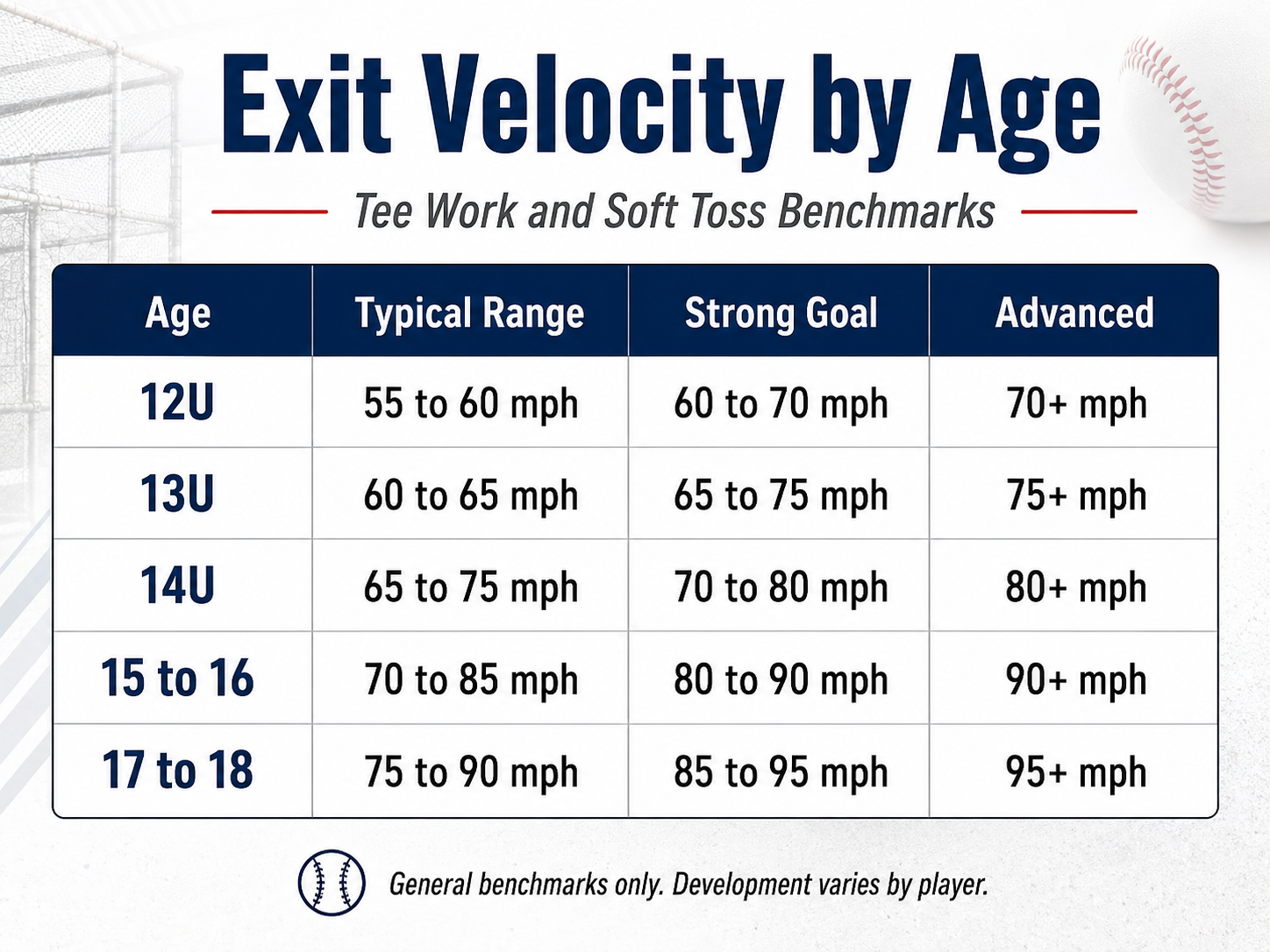
Exit velocity by age
These ranges are meant to give parents and players context. They are not meant to discourage anyone. A player who is below the typical range may simply need more strength, better sequencing, better contact quality, or more time to physically mature. A player who is above the range still needs to learn how to control the barrel, use the whole field, and produce that contact in game situations.
The better question is not always, “Is this number good for my age?” A better question is, “Can we improve this number while also improving the swing?”
What kind of growth should players expect?
A reasonable expectation for many players is about 3 to 5 mph of exit velocity growth per year through the teen years, although development is rarely that clean. Some players make a bigger jump during a growth spurt. Others grow first, lose some coordination for a while, and then improve once their body catches up.
For players 12 to 14, exit velocity often improves through better contact quality, better lower half sequence, improved posture, and a more consistent barrel path. At this age, the goal is not to force a player into an adult swing. The goal is to help them move better, stay balanced, and learn how to square the ball up more often.
For older players, strength and bat speed become bigger parts of the equation, but the same basic rule still applies. More bat speed only helps if the player can deliver the barrel to the ball. A stronger player who misses the barrel or loses posture will not get the full benefit of that strength.
How the baseline guides cage work
The baseline gives us direction. If a player has a solid peak exit velocity but a much lower average, we may need to work on consistency. If the exit velocity is improving but the ball is being hit too high or too low, we may need to look at contact point and swing path. If a player only hits the ball hard to the pull side, we may need to work on direction and adjustability.
This is where HitTrax becomes more than a screen in the cage. It helps connect the training plan to the player in front of us.
After the baseline, cage work can be built around specific goals. A player may spend time working on clean contact through the middle of the field, then move into rounds focused on harder contact, then finish with more game like swings. The structure depends on what the baseline shows.
We do not want players staring at the numbers after every swing or trying to muscle every ball. The point is to use the data, make adjustments, and then let the player compete. Over time, we can retest and see whether the work is showing up in measurable ways.
Why this matters for players and parents
One of the hardest parts of youth development is knowing whether a player is actually improving. A swing may look better, but the contact may not be better. A player may feel stronger, but the ball may not be coming off the bat any harder. A player may have one great round in the cage, but struggle to repeat it the next week.
A HitTrax baseline helps make development more visible. It gives parents a clearer picture of where their player is starting, and it gives players a way to see progress that is not based only on hits in games. That matters because game results can be messy. A player can hit a ball hard right at someone, or get a hit on weak contact. The cage gives us a controlled environment where we can focus on the quality of the swing and the quality of contact.
Exit velocity should not replace coaching, approach, or feel. It should support them. When used the right way, it helps players understand their swing better and gives them a more honest view of their progress.
At Vicarious Athletics, that is why we start with a baseline. We want players to know where they are, understand what they are working on, and then use their cage time with purpose.
